The reframe
The wrong question in the UPI debate
If a customer pays a merchant ₹1,000 through UPI, the merchant has not created a new economic asset. The customer has simply transferred ₹1,000 that already belonged to them, and the merchant has received ₹1,000 they were already entitled to.
The underlying economic transaction would have happened even without UPI. The customer could have paid in cash. The merchant could have accepted the cash, then used that same cash to pay a supplier, who could have used it to pay another supplier. The same ₹1,000 could circulate several times without a fee being charged at every movement.
UPI changed something else entirely: it converted the movement of money into a digitally recorded, traceable and institutionally observable event. That transformation created enormous value — for banks, payment companies, regulators, fintechs and the formal financial system. So the question isn’t how much the merchant should pay for UPI. It’s why the merchant should pay for infrastructure whose biggest winners sit somewhere else entirely.
The mechanism
Cash had no MDR
A customer has ₹1,000. They buy something from a merchant for ₹1,000. Under cash, that note can move customer → merchant → supplier → another supplier, and no transaction fee is charged at any hop. This is one of physical cash’s defining traits: its infrastructure cost — printing, distribution, security, storage — is fixed and amortised. The marginal cost of moving an existing note from one hand to another is effectively zero.
UPI introduced a different architecture. Every movement becomes a digitally authenticated, routed, recorded and settled event. That creates real infrastructure cost — but it also creates new economic value. The pricing debate has gone wrong precisely at the point where it conflates the two.
The shift
UPI did not just digitise payments
UPI did more than replace a ₹1,000 note with a QR code — it changed the information architecture of commerce. A cash transaction can be economically real without ever becoming a digital record the financial system can see. A UPI transaction creates a structured financial event. Over time, millions of such events can reveal:
- business turnover
- payment frequency
- customer behaviour
- seasonality
- supplier relationships
- cash-flow patterns
- merchant activity
- repayment capacity
- business continuity
- geographic activity
- transaction concentration
- financial behaviour
That information has economic value: it can improve fraud detection, underwriting, customer segmentation, and financial-product distribution, and — with proper consent and safeguards — contribute to alternative credit infrastructure. The merchant doesn’t merely receive a payment through UPI. The financial system receives information about economic activity that was previously much harder to observe.
The map
Who captures that benefit?
This is where the principle of beneficiary pays matters. A UPI transaction has several participants. The merchant receives payment. The customer receives a convenient mechanism. But the financial ecosystem receives much more.
Figure 1
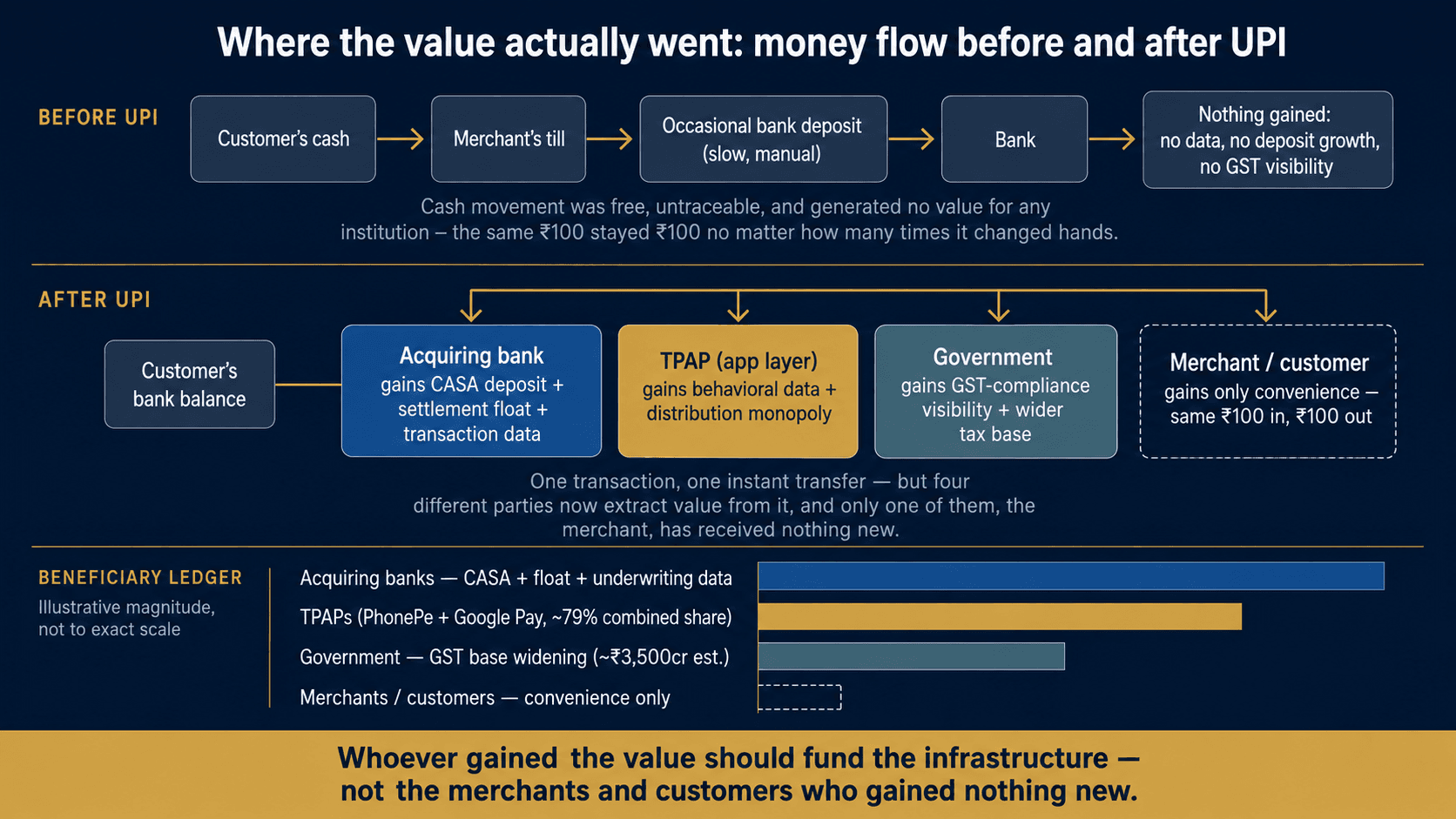
Asking only the merchant to pay for the transaction is economically incomplete. The merchant is being asked to fund a rail whose positive externalities extend far beyond the merchant.
The cost
The merchant did not ask for a second tax on the same sale
Consider a small shopkeeper selling ₹10 lakh worth of goods through UPI. Their fundamental economic activity is selling goods. They already bear inventory costs, rent, salaries, electricity, logistics, taxes, compliance costs, working-capital costs, bad-debt risk and business risk.
The UPI transaction does not create the merchant’s revenue — it merely changes the mechanism through which the customer transfers that revenue. Charging the merchant MDR makes digital payment infrastructure another variable cost of accepting money at all. If cash costs the merchant nothing but digital payment costs 0.3%, the system is effectively saying:
“Use the more transparent and formal payment method, and we will charge you for doing so.”
That is backwards.
The paradox
The paradox of formalisation
For years, India has encouraged merchants to move from cash toward digital payments — for better records, greater transparency, easier reconciliation, improved tax visibility, reduced cash handling, lower theft risk, better financial inclusion, stronger credit histories, and more efficient commerce. The merchant is effectively being encouraged to join the formal financial system.
But once the merchant does so, imposing a fee on every transaction risks creating the opposite incentive. For a large corporation, 0.2–0.3% may be a rounding error. For a small merchant on thin margins, the same percentage can be meaningful — and if it’s passed on to consumers, the system creates friction around the very payment method India spent years trying to make universal.
The asset
The real value of UPI is not the QR code
The physical QR code is not particularly valuable. The digital infrastructure behind it is. The QR code merely says “send money here.” The infrastructure authenticates the payer, routes the transaction, records the event, manages settlement, creates an auditable trail, enables reconciliation, supports fraud detection, and produces data that can support financial services.
The value isn’t in processing one transaction. It’s in building a digital financial network around economic activity — and the institutions operating around that network are positioned to capture the downstream value. That is precisely why they, not necessarily the merchant, should bear the infrastructure cost.
The principle
The beneficiary-pays principle
Those who derive the greatest incremental economic value from UPI should contribute the greatest share of the cost of maintaining it.
This doesn’t mean punishing banks or payment companies for succeeding — it means recognising where value is actually created and captured.
Merchant benefit
Payment arrives more conveniently and securely — real, but also achievable through cash. The incremental gain is mostly convenience, security, reconciliation and formalisation.
Bank benefit
A deeper digital relationship with economic activity: transaction visibility, stronger customer relationships, deposits, and consented data to offer credit and other products.
TPAP & platform benefit
Enormous distribution. UPI becomes the acquisition layer for credit, insurance, investments, merchant services and other digital products — payment as the top of a much larger funnel.
Government benefit
Greater visibility into formal economic activity — substantial value for taxation, compliance, financial inclusion and economic measurement.
The misread
Stop treating every transaction as the product
If UPI is treated as a conventional payment-processing business, the instinct is transaction → cost → MDR. But UPI is not a payment processor — it’s a public digital financial infrastructure layer, and its value compounds with scale. The millionth transaction is not economically equivalent to the first: the network now carries more participants, more interoperability, more merchant acceptance, deeper transaction history, better fraud intelligence, stronger financial relationships, and more opportunities for financial services.
Charging the merchant mechanically for every transaction confuses network creation cost with marginal transaction cost.
The analogy
If UPI creates public infrastructure, fund it like infrastructure
Roads aren’t funded by charging every shopkeeper a percentage of every rupee earned because a customer happened to drive there. Telecom isn’t necessarily funded by charging the recipient of every call a share of the conversation’s value. Electricity grids aren’t financed by charging a percentage of the value created by every machine connected to them. Infrastructure is generally financed by who benefits, who uses it, and who captures the resulting value — spread across several payers.
Figure 2 · illustrative, not sourced data
The proposal
The better question for UPI monetisation
Instead of asking “should merchants pay 0.2%, 0.3% or 0.5% MDR?”, India should ask how much each participant benefits from UPI, and what is the fairest way to recover cost from those beneficiaries. That could produce a completely different architecture: small-value merchant transactions remain zero-MDR, and infrastructure is funded through a combination of government support, contributions from institutions capturing downstream value, network participation fees, institutional service fees, and carefully designed large-value transaction economics.
Figure 3 · illustrative reallocation, not a proposed rate card
The objective is simple: do not make the smallest merchant pay for the financial ecosystem’s most valuable infrastructure.
The stakes
This is especially important for MSMEs
India has millions of small businesses. For them, UPI isn’t a luxury — it’s becoming part of the basic operating infrastructure of commerce. A street vendor, kirana store, mechanic, restaurant, freelancer or small manufacturer may accept hundreds of digital payments without the pricing power of a large corporation.
A 0.3% charge sounds insignificant in isolation. But economics isn’t about the percentage in isolation — it’s about who has pricing power and who does not. A large corporation can negotiate. A small merchant cannot. That is exactly why infrastructure pricing should avoid transferring disproportionate cost onto the weakest participant in the network.
The irony
We are charging the person who creates the data
The merchant generates the economic activity. The customer generates the payment. The transaction creates the financial record. Yet the institutions sitting on top of the infrastructure can extract value from the resulting information and financial relationship — better credit underwriting, fraud prevention, customer acquisition, product distribution — value beyond the payment itself.
The merchant shouldn’t be charged simply for participating in creating that value. The better question is: can some of that value fund the infrastructure that generated it?
The test
UPI should make commerce cheaper, not more expensive
The ultimate test should be brutally simple: did digitisation make commerce more efficient? If yes, the efficiency gains should flow through the economy — as lower payment friction, faster settlement, cheaper reconciliation, better access to credit, lower cash-handling costs, better fraud protection, greater financial inclusion, and more competitive financial services.
If the end result is “you used the digital public infrastructure, therefore you owe us 0.3% of your sale,” we have turned an infrastructure revolution into a toll booth.
The principle
The person receiving their own money should not automatically be charged for the infrastructure that makes the movement of that money visible and valuable to the financial system.
Or more simply: don’t charge the merchant for creating a financial transaction that benefits the financial system more than it benefits the merchant. UPI succeeded because it removed friction from moving money. Its next stage shouldn’t be about finding new ways to put friction back in — it should be about designing an economic model in which the largest beneficiaries of the network fund the network.
The merchant should be able to sell a ₹1,000 product and receive ₹1,000, just as they would if the customer had handed them a ₹1,000 note. If banks, payment platforms and the broader financial system derive additional value from transforming that cash transaction into a traceable digital financial event — that additional value, not the merchant’s sale, should be the starting point for paying for UPI.
UPI should be a public digital rail for commerce—not a toll collected from the people using it.